Jaffarabadi Buffalo Breed Guide: Physical Traits, Origin, Horn Structure & Dairy Management Guide
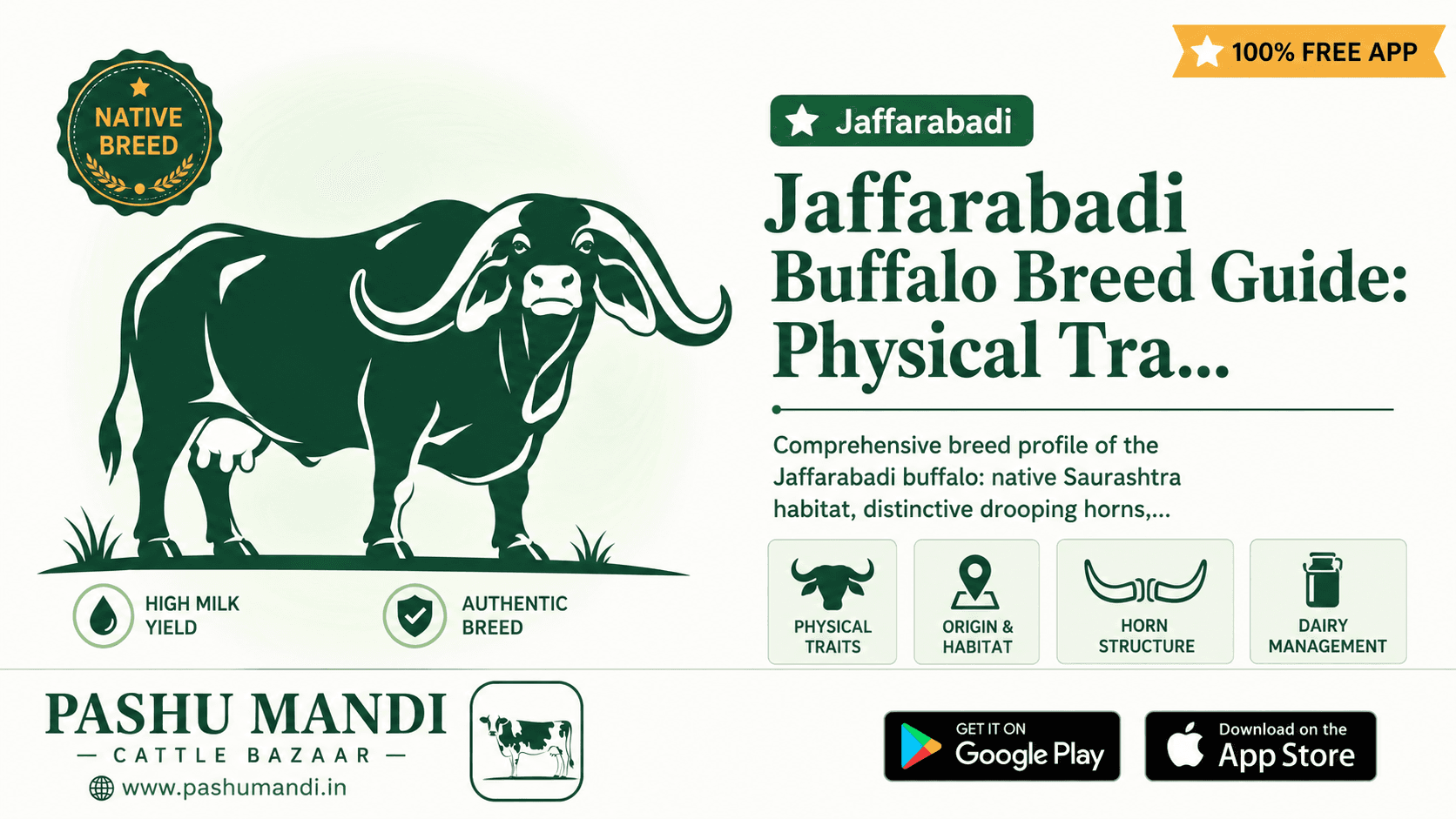
Introduction to the Jaffarabadi Buffalo
The Jaffarabadi buffalo is one of the heaviest and most magnificent riverine buffalo breeds native to India. Named after the coastal town of Jafrabad in the Amreli district of Gujarat, this breed is also known regionally as Bhavnagri, Gir, or Jafari. Registered with the ICAR-National Bureau of Animal Genetic Resources (NBAGR), the Jaffarabadi is highly prized by progressive dairy farmers for its impressive milk production, exceptional butterfat content, and robust constitution.
Bred traditionally by the pastoral Maldhari communities within the fringes of the Gir forest and Saurashtra peninsula, the Jaffarabadi possesses remarkable physical strength and foraging efficiency under diverse feeding regimes.
Native Breeding Tract and Geographical Origin
The natural breeding tract of the Jaffarabadi buffalo encompasses the entire Saurashtra peninsula of Gujarat. The core populations are concentrated across the following districts:
- Junagadh & Gir Somnath: Deep within the forested and semi-arid tracts of the Gir sanctuary zone.
- Amreli & Bhavnagar: Coastal and inland talukas where traditional pastoralists have maintained pure breed lines for generations.
- Porbandar, Jamnagar & Rajkot: Expanded commercial and agricultural zones where Jaffarabadi crosses and pure herds thrive.
Distinctive Physical Characteristics
The Jaffarabadi is easily identified by its massive body frame and unique cranial features:
- Body Conformation: It is the largest of Indian buffalo breeds. The body is long, deep, and heavy-boned, with a broad chest and a well-muscled barrel. Mature males typically weigh between 600 to 800 kg, while adult females range between 500 to 650 kg.
- Head & Forehead: The head is large with a strikingly prominent, dome-shaped (convex) forehead that bulges forward between the eyes.
- Unique Horn Structure: The horns are heavy, broad, flat, and droop downwards along the sides of the neck, curving slightly upwards at the tip like a hook. In older animals, the horns may partially cover the outer corners of the eyes.
- Coat & Skin Color: The coat color is predominantly deep black. Animals with small white patches on the forehead or tail switch are occasionally observed, though solid black is standard.
- Udder & Teat Development: Well-developed, bowl-shaped udder with prominent, tortuous milk veins and uniformly placed cylindrical teats that facilitate easy hand or machine milking.
Breed Comparison: Jaffarabadi vs. Other Prominent Indian Buffaloes
| Trait | Jaffarabadi | Murrah | Nili-Ravi |
|---|---|---|---|
| Origin | Saurashtra, Gujarat | Haryana & Punjab | Punjab (Ferozepur / Sutlej-Ravi) |
| Horn Type | Broad, flat, heavy, drooping downward | Short, tightly coiled inward | Small, tightly curled |
| Body Size | Very large & heavy-boned | Medium-large, compact wedge shape | Medium-large, deep barrel |
| Average Butterfat % | 7.5% – 9.0%+ | 7.0% – 8.5% | 6.8% – 8.0% |
| Distinguishing Marker | Bulging forehead & drooping flat horns | Jet-black coat & spiral horns | Panch Kalyani (5 white markings) |
Milk Production and Butterfat Profile
The Jaffarabadi buffalo is recognized as a premier dairy producer, particularly favored by ghee manufacturers and sweet makers due to its dense, nutrient-rich milk:
- Lactation Yield: Under good farm management and nutritional care, lactation yield typically ranges from 2,000 to 2,600 kg per lactation cycle (305 days), with superior selective-bred animals yielding over 3,000 kg.
- Butterfat Concentration: One of the highest among riverine buffaloes, fat percentages routinely range between 7.5% and 9.5%, yielding substantial amounts of rich cream and high-grade desi ghee.
- Lactation Length: Animals typically exhibit sustained lactation ranging from 280 to 320 days, maintaining steady daily output when provided adequate dry-matter nutrition.
Note: Individual milk yield and fat percentage vary significantly depending on genetics, lactation parity, age, balanced ration feeding, and climate-control management.
Housing, Nutrition, and Health Management
To realize the genetic potential of the Jaffarabadi buffalo, farm owners must implement structured husbandry protocols:
1. Housing and Thermal Protection
Due to their dark pigmentation and heavy body mass, Jaffarabadi buffaloes have fewer sweat glands per unit area compared to zebu cattle and are highly susceptible to heat stress. Providing spacious sheds with high roofing, natural cross-ventilation, shaded loafing areas, and a wallowing tank or misting sprinklers twice daily during hot summer months is critical for sustaining peak lactation.
2. Balanced Ration and Feeding
Given their large frame, dry matter (DM) intake requirements are substantial. A balanced daily diet should comprise:
- Green Fodder: 25–35 kg of succulent fodder such as maize, sorghum, oats, berseem, or hybrid Napier grass.
- Dry Roughage: 5–8 kg of quality wheat straw, paddy straw, or sorghum stover to support proper ruminal fermentation.
- Concentrate Feed: 2–3 kg for maintenance, supplemented with an additional 400–500 grams per kilogram of milk produced, incorporating oilcakes (cottonseed or mustard cake), grains, wheat bran, and 2% mineral-vitamin mixture with salt.
3. Preventive Health Care
Maintain an active herd health calendar in consultation with a qualified veterinarian:
- Timely vaccination against Hemorrhagic Septicemia (HS), Black Quarter (BQ), and Foot-and-Mouth Disease (FMD) before monsoon onset.
- Routine seasonal deworming against internal flukes and roundworms.
- Strict post-milking teat dipping with antiseptic solutions to prevent mastitis in high-yielding quarters.
Selecting and Purchasing Jaffarabadi Buffaloes
When purchasing Jaffarabadi buffaloes for commercial dairy or breeding programs, buyers should verify parental pedigree where available, inspect the true curvature of horns and forehead dome, examine teat spacing and udder elasticity, and conduct consecutive test milkings over 24 to 36 hours.
Dairy entrepreneurs can utilize Pashu Mandi to discover verified listings of quality dairy buffaloes across Gujarat and western India, comparing health records and verified lactation data directly with reputable dairy farmers.
Important Note
The information in this article is for general educational purposes only. It is not professional veterinary advice, legal advice, or financial advice. Always consult a qualified veterinarian for animal health decisions, a legal professional for legal matters, and a financial advisor for investment decisions. Livestock prices, market conditions, and practices vary by region and change over time — please verify with local sources before making important decisions. This content does not represent the views of any government body and does not guarantee any specific outcome. Found an error? Email us at info@pashumandi.in.
Frequently Asked Questions
Related Articles
Banni Buffalo Breed Guide: Kutch Origin, Physical Traits, Nocturnal Grazing & Dairy Care
Comprehensive guide to the Banni buffalo breed of Kutch: physical characteristics, nocturnal grazing habits, milk traits, climate resilience, and management.
Gujarat Livestock Mandis and Cattle Bazaars: Major Markets, Native Breeds & Farmer Guide
Comprehensive guide to livestock markets, cattle trading hubs, native breeds (Gir, Kankrej, Jaffarabadi, Mehsana), and market practices in Gujarat.
Murrah Buffalo Breed Guide: Physical Characteristics, Origin, and Dairy Management
Complete guide to the Murrah buffalo breed: origin, physical traits, housing, nutrition principles, and management practices for Indian dairy farmers.
Ready to Buy or Sell Cattle?
Download Pashu Mandi — India's trusted cattle marketplace. Browse thousands of listings, connect with sellers directly, and find your perfect animal.