Dairy Cattle Udder Conformation and Health: Buyer Inspection Checklist
Importance of Udder Conformation in Dairy Cattle Selection
When purchasing dairy cows or buffaloes for commercial dairy farming or household milk production, the physical examination of the udder and mammary system is arguably the single most critical evaluation step. The mammary system directly determines productive lifespan, milking efficiency, and susceptibility to chronic conditions like mastitis.
A high-producing animal with weak udder attachments or defective teat conformation often suffers premature culling due to teat injuries, recurring infections, or breakdown of supportive ligaments. Systematic buyer inspection helps identify sound, long-lasting dairy animals.
Core Anatomical Components to Inspect
A thorough pre-purchase evaluation involves examining four major structural areas of the mammary system:
1. Fore Udder Attachment
- Desirable Structure: The fore udder should extend moderately forward along the abdominal wall with a smooth, firm blend rather than an abrupt break or shelf.
- Defects to Avoid: Loose, broken, or dropped fore udder attachments that swing excessively during walking, predisposing the tissue to bruising.
2. Rear Udder Attachment and Height
- Desirable Structure: The rear udder should attach high and wide beneath the pin bones. Both rear quarters should exhibit balanced fullness and symmetry.
- Defects to Avoid: Narrow, low-attached rear udders that bunch tightly between the thighs or drop below the hock joint.
3. Median Suspensory Ligament (Udder Cleft)
- Desirable Structure: A distinct, well-defined vertical crease running between the left and right halves of the udder. This ligament carries the primary weight of milk and tissue.
- Defects to Avoid: A flat or rounded udder floor indicating ligament breakdown, which causes teats to splay outward and the udder base to hang dangerously low.
4. Teat Placement, Shape, and Size
- Desirable Placement: Teats should be placed squarely under the center of each quarter, hanging perpendicular (straight down) to the ground.
- Optimal Dimensions: Moderate cylindrical shape (typically 5 to 7 cm long) of uniform diameter, facilitating comfortable manual or machine milking.
- Defects to Avoid: Funnel-shaped teats, excessively bulbous or needle-thin teats, blind quarters, supernumerary (extra) teats connected to gland tissue, or teats pointing outward horizontally.
Step-by-Step Udder Palpation Checklist (Hands-On Exam)
Never rely solely on visual inspection from a distance. Always conduct a hands-on physical examination both before and immediately after complete milking:
| Inspection Stage | What to Look and Feel For | Warning Signs / Red Flags |
|---|---|---|
| Full Udder (Pre-Milking) | Even distension across all four quarters, balanced symmetry, soft warm skin without lesions or warts. | One quarter noticeably larger, hot, hardened, or painful to the touch. |
| Milking Process | Smooth, uninterrupted milk stream from all four teats; comfortable extraction without straining or kicking. | Hard milk flow (tight sphincter), spraying streams, milk leakage between milkings, or blocked teats. |
| Milk Examination | Clean, uniform, white to creamy milk without abnormal odour, flakes, or sediment. | Watery milk, visible clots, flakes, strings, blood tinges, or foul smell. |
| Empty Udder (Post-Milking) | Significant collapse of glandular tissue; soft, pliable, and spongy texture throughout all quarters. | Firm, meaty, fibrous quarters that do not shrink after milking (indicative of chronic mastitis or fibrosis). |
Common Udder Faults and Long-Term Risks
Understanding the implications of specific udder conformation faults allows buyers to make informed purchasing decisions:
- Pendulous Udder: Udder hanging below the hocks is prone to stepping injuries, contamination from muddy floors, and higher mastitis incidence.
- Blind or Dead Quarters: A quarter that produces little to no milk due to past infection permanently reduces overall lactation capacity.
- Hard Nodules and Fibrosis: Internal scar tissue from unresolved clinical mastitis permanently damages milk-secreting alveoli.
- Leaky Teats (Incontinentia Lactis): Weak teat sphincter muscles permit spontaneous milk dripping, wasting yield and allowing bacterial entry.
Buyer Best Practices Before Finalizing Purchase
Follow these standard verification steps to safeguard your investment:
- Perform at least two consecutive supervised milkings (morning and evening) to verify yield and udder emptying.
- Use a strip cup to examine fore-milk from each teat separately before each milking.
- Engage a qualified local veterinarian to perform an independent physical health and reproductive soundness examination.
Important Note
The information in this article is for general educational purposes only. It is not professional veterinary advice, legal advice, or financial advice. Always consult a qualified veterinarian for animal health decisions, a legal professional for legal matters, and a financial advisor for investment decisions. Livestock prices, market conditions, and practices vary by region and change over time — please verify with local sources before making important decisions. This content does not represent the views of any government body and does not guarantee any specific outcome. Found an error? Email us at info@pashumandi.in.
Frequently Asked Questions
Related Articles
Dairy Cattle Buying Guide: Step-by-Step Physical Inspection Checklist
Essential physical inspection checklist and safety guide for farmers buying dairy cows and buffaloes in local mandis or online marketplaces.
Dairy Cattle Mastitis Prevention & Udder Health: Hygiene Protocols, Milking Routines & Early Detection Guide
Comprehensive practical guide to mastitis prevention in dairy cows and buffaloes: milking hygiene, strip cup testing, teat dipping, dry cow management, and veterinary care.
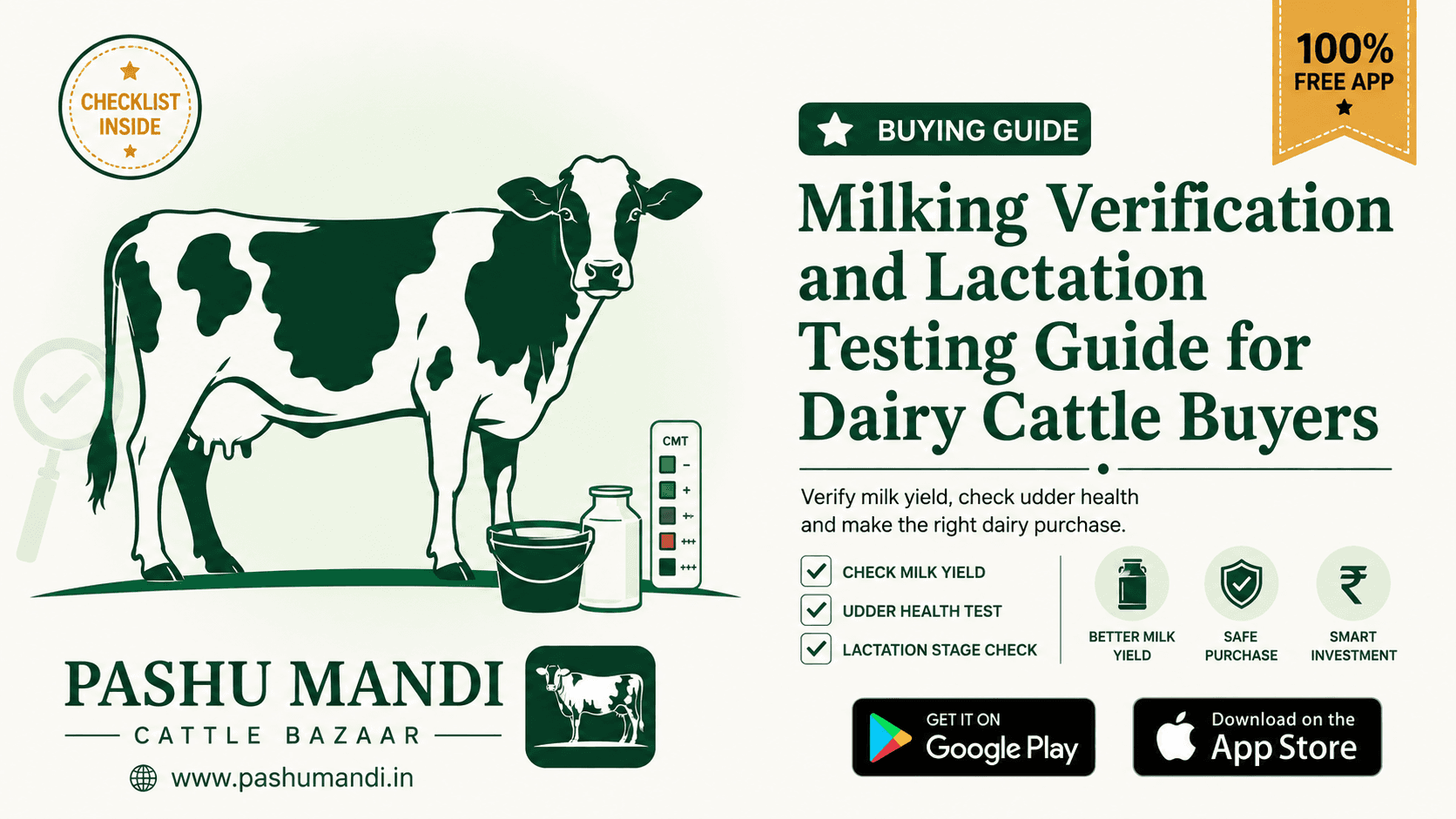
Milking Verification and Lactation Testing Guide for Dairy Cattle Buyers
Comprehensive practical guide for dairy farmers on verifying milk yield, checking udder health, testing all four quarters, and conducting standard milking checks.
Ready to Buy or Sell Cattle?
Download Pashu Mandi — India's trusted cattle marketplace. Browse thousands of listings, connect with sellers directly, and find your perfect animal.