Mehsana Buffalo Breed Guide: Physical Traits, Milk Potential, and Management
Introduction to the Mehsana Buffalo Breed
The Mehsana buffalo is one of the most commercially valuable and widely respected dairy buffalo breeds in India. Originating in the northern and central regions of Gujarat—particularly the Mehsana, Sabarkantha, Banaskantha, Gandhinagar, and Ahmedabad districts—this breed was developed through the evolutionary interbreeding and selective stabilization of two premier Indian buffalo breeds: the high-yielding Murrah and the hardy, efficient Surti.
Due to its balanced genetic heritage, the Mehsana buffalo combines the robust body frame and outstanding milk potential of the Murrah with the docile temperament, regular breeding habits, and economical feed conversion efficiency of the Surti. Today, Mehsana buffaloes form the backbone of cooperative dairy networks in Gujarat and are increasingly reared by commercial dairy farmers across Rajasthan, Maharashtra, and Madhya Pradesh.
Origin, Habitat, and Distribution
The native breeding tract of the Mehsana buffalo encompasses the semi-arid plains of North Gujarat. The breed evolved in an agro-climatic environment characterized by warm summers, moderate winters, and seasonal forage availability. Over decades, local pastoralists, farmers, and cooperative milk unions fostered systematic selective breeding to prioritize persistence in milk yield, short intercalving intervals, and docility.
Today, Mehsana buffaloes are recognized across the country for their adaptability to intensive stall-feeding systems as well as semi-intensive grazing management, making them an excellent choice for progressive dairy enterprises.
Physical Characteristics and Conformation
Recognizing a genuine Mehsana buffalo requires attention to specific breed-conformation markers:
- Head and Forehead: The head is relatively long, clean-cut, and balanced with a broad forehead. The facial profile is straight and conveys a calm, docile expression.
- Horns: Horn conformation is a key identifying trait. Horns are generally intermediate between the tightly curled spirals of the Murrah and the flat, sickle shape of the Surti. They typically curve upward, backward, and then inward towards the tip, forming a semi-sickle or loose spiral contour.
- Coat and Skin Color: The coat color is predominantly black or dark greyish-black. Some animals exhibit a brownish tinge, particularly around the shoulders or flank during dry summer months.
- Body Conformation: The body is medium-sized, compact, and possesses a well-balanced dairy wedge. The chest is deep with well-sprung ribs, providing ample digestive and respiratory capacity.
- Neck and Dewlap: The neck is moderately long and lean in females, blending smoothly into the shoulders. The dewlap is small and tightly attached.
- Udder and Teats: Well-developed, capacious udder with a balanced floor, squarely placed teats of uniform size, and prominent mammary veins.
Lactation Performance and Dairy Potential
Mehsana buffaloes are highly regarded in the dairy sector for several distinct productive advantages:
| Production Parameter | Breed Characteristics & Observations |
|---|---|
| Lactation Consistency | High lactation persistency; maintains steady daily milk output across extended lactation cycles. |
| Butterfat Content | Typically ranges from 6.5% to 7.5%, varying with nutrition, stage of lactation, and individual genetics. |
| Intercalving Interval | Known for regular reproductive cyclicity and shorter dry periods compared to several other regional breeds. |
| Temperament | Docile, easily handled by farm family members, and well-suited to machine milking or hand milking. |
Individual milk yield is governed by balanced feeding, clean drinking water availability, genetics, and herd management practices. Farmers investing in Mehsana stock should evaluate pedigree records and maternal lactation history rather than relying solely on generalized claims.
Feeding and Nutritional Management
To sustain optimal milk synthesis and maintain reproductive health, Mehsana buffaloes require a scientifically balanced ration:
- Quality Green Fodder: Provide 25–35 kg of succulent green fodder daily, such as berseem, lucerne, maize, sorghum, or hybrid Napier grass, to fulfill vitamin and moisture requirements.
- Dry Roughage: Offer 4–6 kg of clean dry roughage (such as wheat straw, paddy straw, or sorghum stover) to maintain rumen fill and promote healthy rumination.
- Balanced Concentrate Feed: Provide a quality compound cattle feed with adequate crude protein (18–20%) and energy (total digestible nutrients). A standard maintenance allowance plus an additional production allowance per liter of milk produced ensures body condition is preserved.
- Mineral Mixture and Salt: Supply 50–60 grams of area-specific chelated mineral mixture and 30 grams of common salt daily to support metabolic functions and reproductive regularity.
- Water Ad Libitum: Ensure continuous access to clean, fresh drinking water. High-producing buffaloes consume 70–100 liters of water daily, especially during warm weather.
Housing, Comfort, and Heat Stress Management
Buffaloes have dark skin with fewer active sweat glands compared to humped cattle (Zebu cows), making them naturally susceptible to heat stress. Effective housing and management practices include:
- Well-Ventilated Sheds: Construct open, well-ventilated sheds with heat-reflective roofing (such as thatched roofs, tiles, or insulated sheets) with adequate ridge ventilation.
- Water Misting and Wallowing: Provide misting nozzles, overhead fans, or access to clean wallowing tanks during peak summer hours to facilitate evaporative cooling.
- Clean and Dry Bedding: Keep the resting area clean, dry, and well-drained with non-slippery flooring to protect hooves and prevent environmental mastitis.
- Routine Biosecurity & Healthcare: Maintain timely deworming, vaccination against Hemorrhagic Septicemia (HS) and Black Quarter (BQ), and regular herd health checks in consultation with a registered veterinary professional.
Related reading: Kankrej Cattle Breed Guide: Physical Traits, Lyre Horns, Origin & Dual, Murrah Buffalo Breed Guide: Physical Characteristics, Origin, and Dair.
Important Note
The information in this article is for general educational purposes only. It is not professional veterinary advice, legal advice, or financial advice. Always consult a qualified veterinarian for animal health decisions, a legal professional for legal matters, and a financial advisor for investment decisions. Livestock prices, market conditions, and practices vary by region and change over time — please verify with local sources before making important decisions. This content does not represent the views of any government body and does not guarantee any specific outcome. Found an error? Email us at info@pashumandi.in.
Frequently Asked Questions (FAQs)
1. What makes the Mehsana buffalo different from the Murrah buffalo?
While the Murrah has tightly curled horns, a massive barrel, and a deep pitch-black coat, the Mehsana is a genetic derivative of Murrah and Surti crosses. The Mehsana typically has semi-curled or sickle-shaped horns with an upward curve, a slightly lighter and more compact frame, and is widely renowned for high lactation persistence and docility.
2. Is the Mehsana buffalo suitable for commercial dairy farming?
Yes. Mehsana buffaloes are exceptionally well-suited to commercial dairy farming due to their calm temperament, efficient feed conversion, good butterfat percentage, and adaptability to both stall-feeding and semi-intensive dairy operations.
3. How much water does a lactating Mehsana buffalo need every day?
A lactating Mehsana buffalo typically requires between 70 and 100 liters of clean, fresh drinking water daily, depending on milk yield, ambient temperature, and humidity levels.
4. What regions in India are best suited for rearing Mehsana buffaloes?
While indigenous to North Gujarat, Mehsana buffaloes thrive across semi-arid and tropical regions of India, including Gujarat, Rajasthan, Maharashtra, Madhya Pradesh, and Haryana, provided proper shelter and heat-stress management are maintained.
Frequently Asked Questions
Related Articles
Deoni Cattle Breed Guide: Physical Traits, Milk Yield, Draft Ability & Care
An exhaustive guide to the Deoni cattle breed of India, covering native breeding tracts, distinctive morphological strains, lactation performance, draft power, nutrition, and herd management.
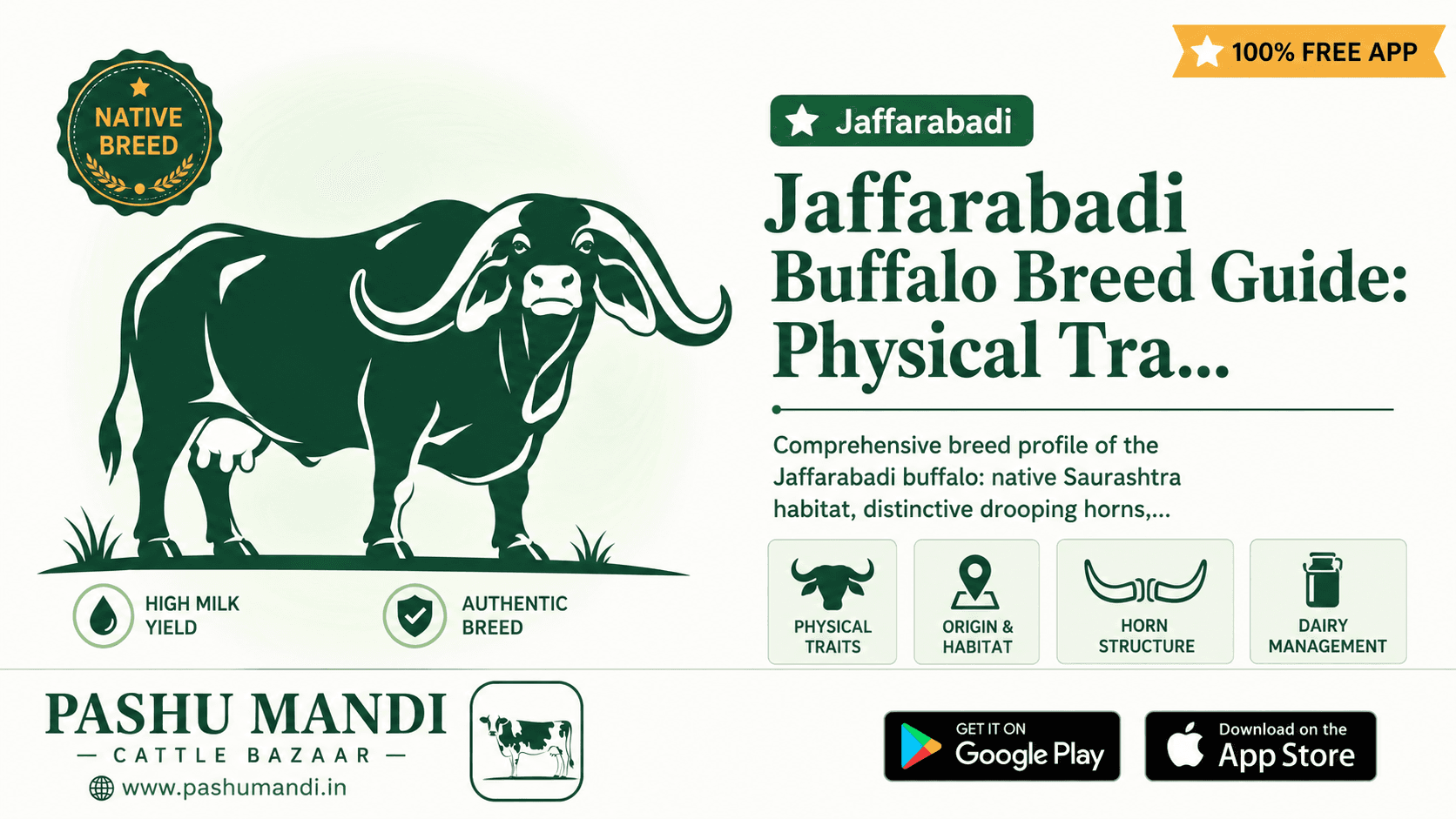
Jaffarabadi Buffalo Breed Guide: Physical Traits, Origin, Horn Structure & Dairy Management Guide
Comprehensive breed profile of the Jaffarabadi buffalo: native Saurashtra habitat, distinctive drooping horns, high butterfat milk production, and care practices.
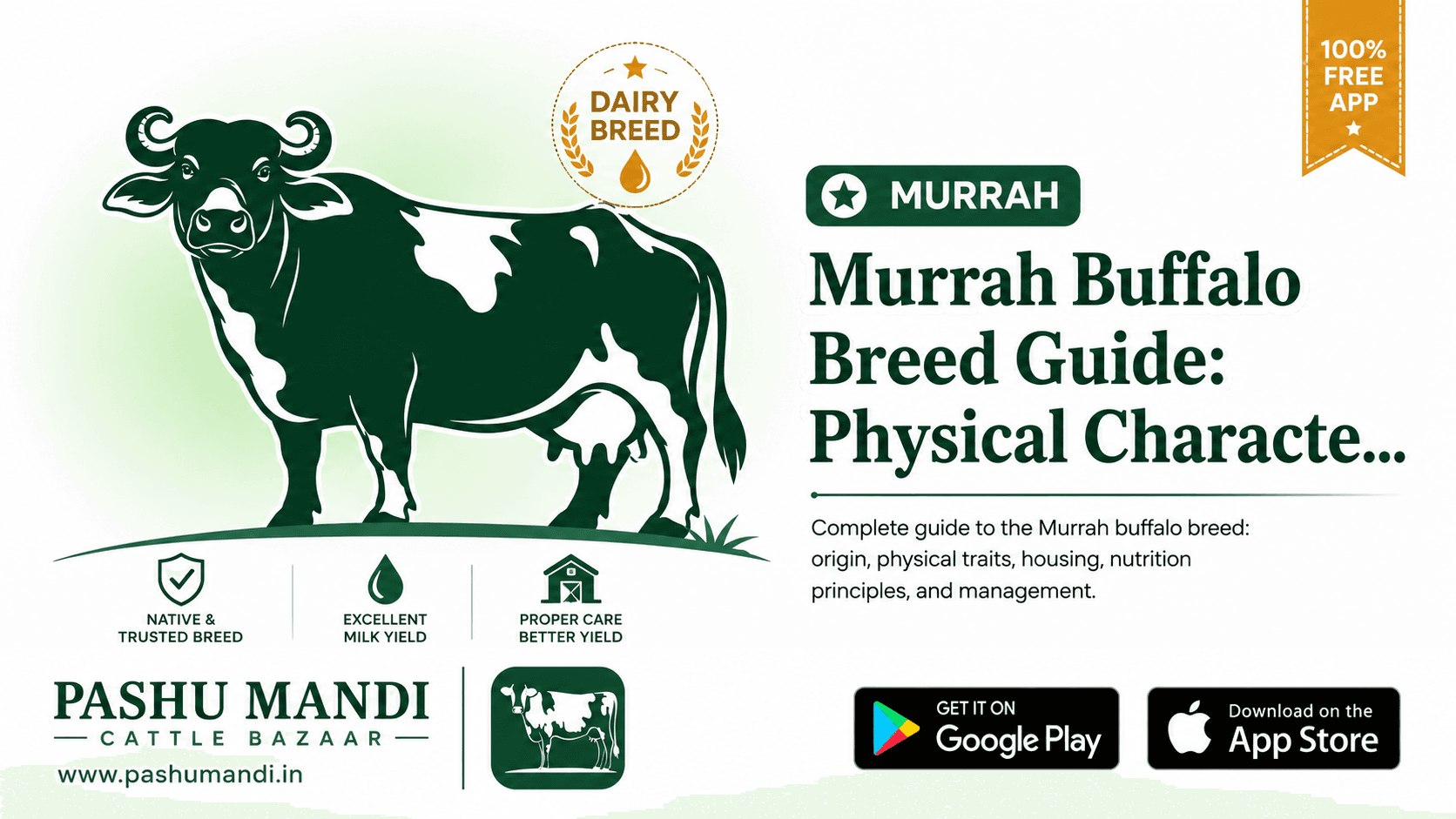
Murrah Buffalo Breed Guide: Physical Characteristics, Origin, and Dairy Management
Complete guide to the Murrah buffalo breed: origin, physical traits, housing, nutrition principles, and management practices for Indian dairy farmers.
Ready to Buy or Sell Cattle?
Download Pashu Mandi — India's trusted cattle marketplace. Browse thousands of listings, connect with sellers directly, and find your perfect animal.